
Holding KAS or Converting It: What a 0.05 BTC Goal Really Costs
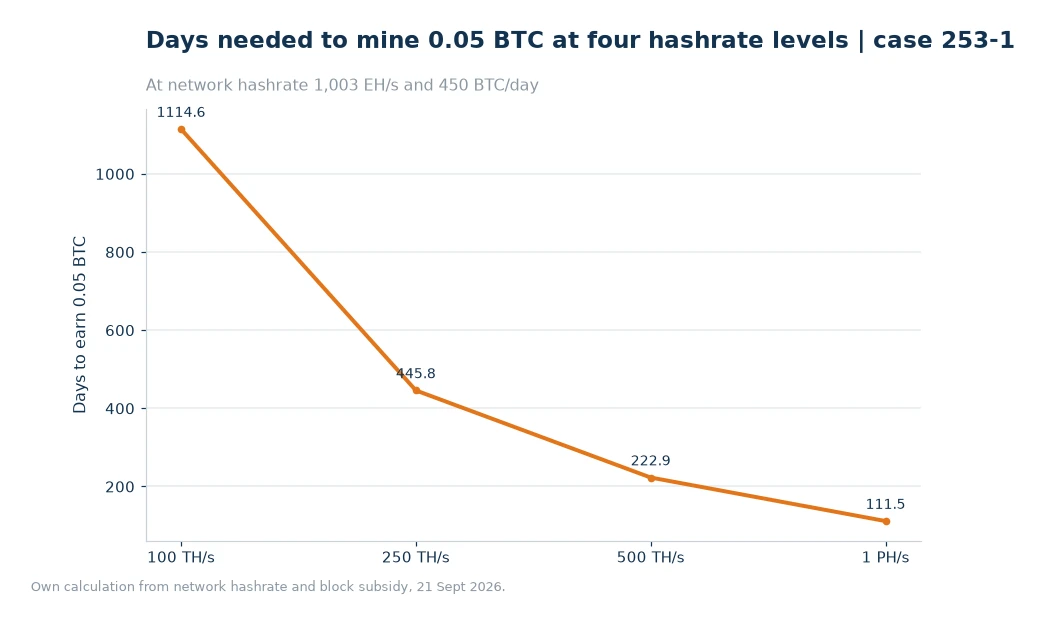
A KAS miner is paid in KAS, so a bitcoin-denominated goal is a conversion with a deadline attached. At the 21 September 2026 network total, 0.05 BTC needs 1,114.6 days at 100 TH/s, 445.8 at 250, 222.9 at 500 and 111.5 at 1 PH/s. At $0.04130647 per KAS the target equals about 102,517 KAS, which is the number the payout actually has to reach.

Key takeaways
- 0.05 BTC equals roughly 102,517 KAS at $0.04130647, so the target is a KAS quantity as much as a BTC figure.
- At 100 TH/s the reference schedule runs 1,114.6 days, over three years.
- If KAS halves against BTC, the same target needs twice the KAS and twice the calendar.
- Decide the conversion rule before the first payout, not after a price move.
A Target in Bitcoin, a Payout in KAS
Mining a smaller-cap coin means the revenue and the goal can sit in different assets. The pool credits KAS because that is the chain being secured. The goal is written in BTC because that is the unit the operator uses for savings. Between the two sits a conversion that happens either automatically or at the moment the operator chooses to trade.
That gap is not a detail. It means the schedule has two moving parts: how much KAS the hardware produces, and how much KAS one bitcoin buys. The first is mining arithmetic and moves slowly. The second can move a great deal in a month, and it is the part most plans leave out. An operator who tracks only the first will be surprised by the finish date even when every machine is healthy.
The Reference Case at Four Hash Rates
The chart prices a 0.05 BTC goal at four hash rates using Bitcoin's issuance and network total. For a KAS operation it is a reference rather than a forecast: it shows how much calendar the goal would take if the same share were working on Bitcoin. The point is the shape of the curve — the target is over three years at 100 TH/s and under four months at 1 PH/s.
Reading it this way keeps the comparison honest. A KAS machine's own output depends on the Kaspa network, a different subsidy and a different difficulty, none of which appear in this chart. What carries over is the method: divide the target by the daily coin output and the result is a number of days.
Converting the Target Into KAS
At $84,692 per BTC, 0.05 BTC is $4,234.60. Divided by $0.04130647 per KAS, that is about 102,517 KAS. A miner who thinks in coin units can now compare the target with the payout history directly: the account has to accumulate roughly a hundred thousand KAS, not a fraction of a bitcoin.
This reframing is useful because it makes the price assumption visible. At $0.08 per KAS the same dollar target would need only about 52,923 KAS; at $0.03 it would need about 141,153. The hardware output does not change with any of those numbers, which is exactly why the target should be stated with its conversion rate attached.
Why the Price Is the Biggest Variable
For a large-cap coin, a 10% weekly move is notable. For a smaller one, the same move can happen in a day, and the effect on a BTC-denominated target is proportional. A plan that assumes today's rate is really a plan that assumes today's market persists for the whole schedule, which is a strong assumption to make silently.
A more robust approach is to test the plan at two rates: today's and one significantly lower. If the lower case pushes the finish beyond the hardware's useful life, the plan is a bet on the exchange rate rather than on the mining. That is worth knowing before the machines are ordered, and it is the sort of thing that is much easier to accept on paper than in a monthly statement.
Pool Readings That Matter for a Small-Cap Coin
The ViaBTC KAS Mining Pool view gives the pool's share and its recent block discovery. For a coin with a smaller network, the pool's own luck can swing more visibly than on Bitcoin, so the luck figure deserves a regular look rather than a glance after a bad week.
Pool Hashrate tells you whether your share of the pool is what you expect; Pool Luck tells you whether the pool's share of the network is converting into blocks at the expected rate. Together they separate a machine problem from a pool-level run of variance.
For hardware comparison, the Miner Profitability Ranking lists models against current conditions, which is a better starting point than a specification sheet.
A Conversion Rule You Can Follow
Pick a rule and write it down. Two common ones are threshold conversion, where KAS is converted whenever the balance exceeds a set amount, and calendar conversion, where a fixed share is converted on the same day each month. Both remove the daily decision, which is the main benefit: a rule set in calm conditions is less likely to be abandoned at a bad moment.
A third option is to hold everything and accept that the BTC goal is denominated in something the operation does not produce. That is a legitimate choice, but it should be labelled as a position rather than a mining target. Naming it correctly prevents a price decline from being read as a hardware failure.
| Hash rate | Days at $0.04130647 | Days if KAS halves | Months at current price |
|---|---|---|---|
| 100 TH/s | 1,114.6 | 2,229.2 | 36.7 |
| 250 TH/s | 445.8 | 891.6 | 14.7 |
| 500 TH/s | 222.9 | 445.8 | 7.3 |
| 1 PH/s | 111.5 | 223.0 | 3.7 |
Worked example
The 100 TH/s case, from the target in dollars to the quantity of KAS required.
- Daily issuance: 144 × 3.125 = 450 BTC.
- Per terahash: 450 ÷ 1,003,000,000 = 0.00000044865 BTC.
- At 100 TH/s: 0.00004487 BTC a day.
- Days to 0.05 BTC: 0.05 ÷ 0.00004487 = 1,114.6.
- Target value: 0.05 × 84,692 = $4,234.60.
- In KAS at $0.04130647: 4,234.60 ÷ 0.04130647 = 102,517 KAS.
- If KAS halves to $0.02065324, the same value needs 205,033 KAS, so the schedule doubles to 2,229.2 days.
- At 1 PH/s the reference schedule is 111.5 days, and the KAS quantity is unchanged at about 102,517.
Frequently asked questions
Should a KAS miner convert payouts to BTC immediately?
There is no universal answer. Immediate conversion fixes the BTC value of each payout and removes price exposure, while holding keeps exposure to KAS. Choose a rule in advance and apply it consistently rather than deciding case by case.
Why does the schedule double when KAS falls?
Because the target is priced in BTC while the payout is in KAS. A lower KAS price means more KAS is needed for the same BTC value, and at a fixed production rate that takes proportionally longer.
Does pool luck matter more on a smaller network?
It can appear to. A smaller pool finds fewer blocks, so short windows are noisier and a run of bad luck is more visible. Judge it over several weeks before drawing a conclusion about the pool.
Write the Rule Before the First Payout
State the target in both units, attach the conversion rate you used and choose how payouts will be handled. That single page answers most of the questions that arise later, and it makes a price move a known variable rather than a surprise. The multi-currency wallet keeps the KAS balance and any converted coin in the same account, which simplifies the record.
If the lower-price case still finishes inside the hardware's life, the plan is sound at either rate. If it does not, the plan depends on a market call that has nothing to do with the machines.
KAS at $0.04130647 and BTC at $84,692 were read on 21 Sept 2026, together with 1,003 EH/s, 132.76 T difficulty, a 3.125 BTC subsidy and 144 blocks a day, from the ViaBTC KAS pool, miner ranking and wallet pages[1]. Published 24 Oct 2026; prices are a single-day reading.